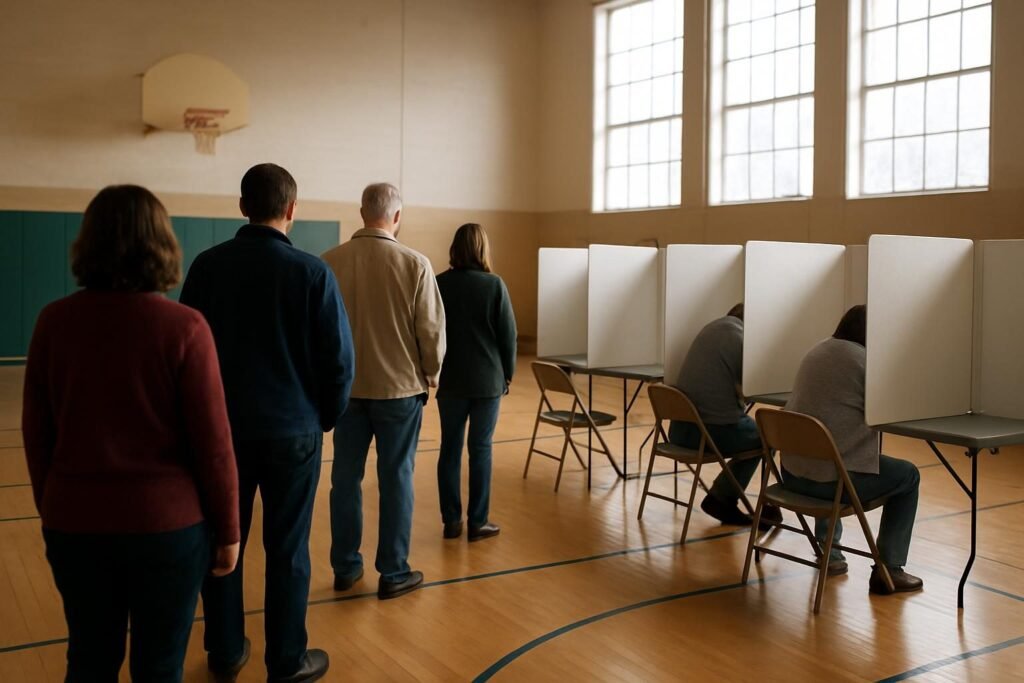
Walk into almost any American election and you will find two names that matter most, one with a red label and one with a blue label. It can feel like the natural order of things, but it is not written anywhere in the Constitution. If you have ever wondered why do we have a two-party system, the answer has less to do with human nature and more to do with how we count votes.
Quick answer: America has two dominant parties mainly because of election rules. When each district elects one winner and the most votes wins, a pattern known as Duverger’s law tends to push voters and candidates toward two big coalitions. Reforms like ranked-choice voting and proportional representation change those incentives, but they bring their own tradeoffs.
The Constitution Does Not Mention Parties
Here is a fact that surprises many people: the word “party” does not appear in the Constitution. Several leading Founders worried about factions, which they saw as groups pursuing their own interests at the expense of the whole. Yet organized parties appeared within the first decade of the republic, as people with shared goals discovered that coordinating was the best way to win.
The names and platforms of the major parties have changed several times over American history. The country has had different party pairings in different eras, and a few periods with more than two serious contenders. What stayed fairly constant was the two-sided structure. For the longer story, see our plain guide to American history that explains today.
So the Constitution did not create the two-party system. Something else did, and it hides in plain sight: the way we run elections.
Duverger’s Law: How Winner-Take-All Rules Work
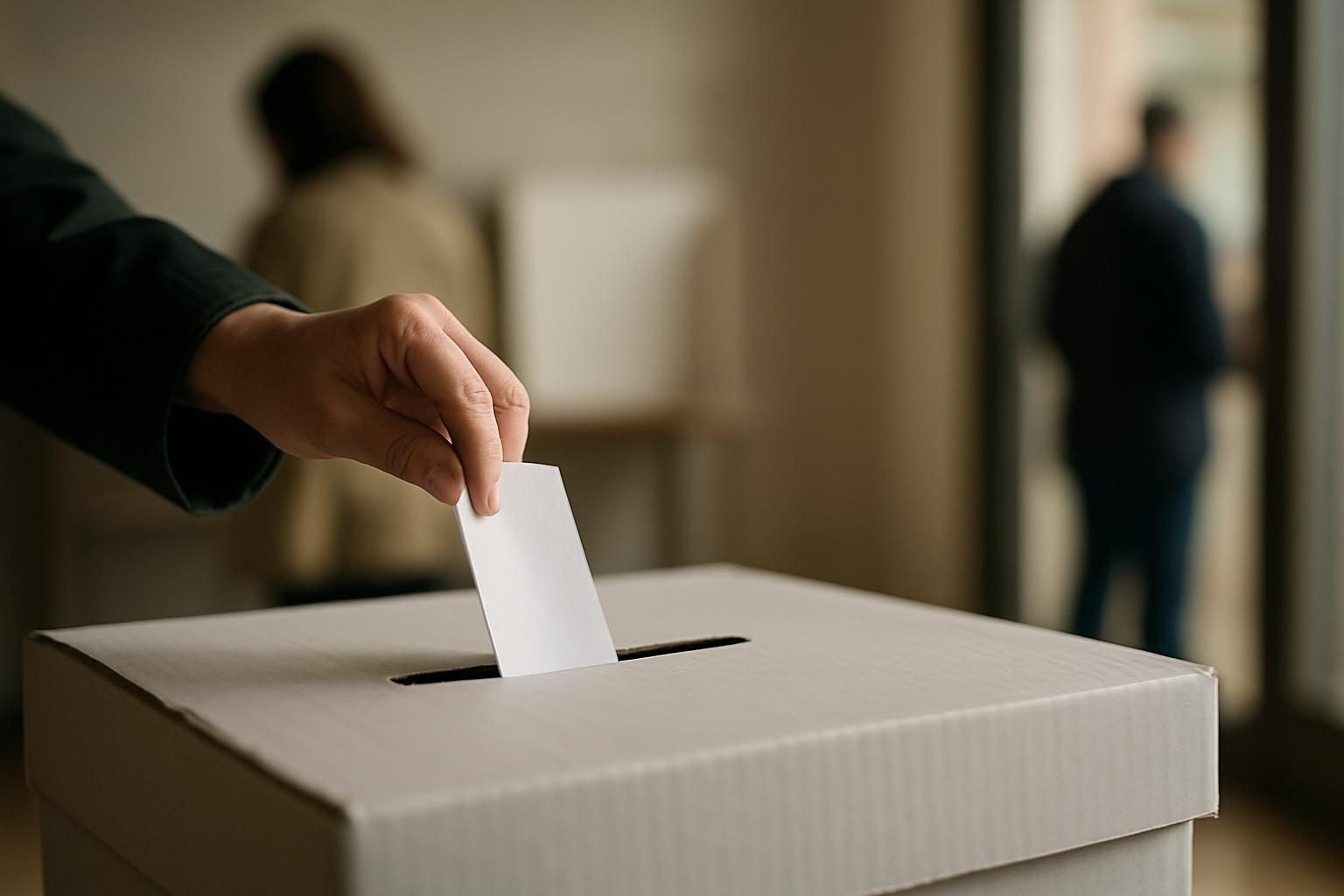
Most American elections use what is called plurality, single-winner districts. Each district elects one person, and whoever gets the most votes wins, even without a majority. Political scientists often call this “first past the post.” There is no prize for second place.
Maurice Duverger, a French political scientist, noticed that places using this kind of system tended to end up with two main parties. The pattern is now called Duverger’s law. It is better understood as a strong tendency than a law of physics, and there are exceptions.
Why the incentives push toward two sides
The effect works through two groups of people making sensible choices. Neither group is plotting anything. They are simply responding to the rules.
- Voters do not want to “waste” a vote. If a third-party candidate has little chance of winning, many voters pick the major candidate they dislike least instead.
- Candidates and donors want to win. Ambitious politicians join a party that can actually carry them to victory, and donors back the contenders who can win.
Over time, these choices feed each other. Voters back the strongest options, which makes those options stronger, which makes smaller parties look even less viable.
The spoiler effect
Imagine an election where 45 percent of voters prefer a conservative candidate, 40 percent prefer a liberal candidate, and 15 percent prefer a third candidate who shares many views with the liberal. Under plurality rules, the conservative wins with 45 percent, even though 55 percent of voters wanted someone else. The third candidate “spoiled” the race for the closest rival.
This is only a hypothetical, but the fear of it is real and powerful. It makes many voters hesitant to support anyone outside the two big parties, and it makes the big parties wary of splintering.
The two-party system is less a choice voters made than a result of how the votes are counted.
Other Rules That Reinforce the Pattern
Duverger’s law is the foundation, but several other features of American politics keep two parties in place.
The presidency and the Electoral College
The presidency is a single prize, and in almost every state the winner of the state’s popular vote takes all of its electoral votes. That structure rewards broad coalitions. To learn how this works, read how the Electoral College works, with pros and cons.
Ballot access, debates and money
States set their own rules for getting on the ballot, and the requirements vary widely. Some are modest, while others demand large numbers of signatures. Major parties are often placed on the ballot automatically, while smaller parties must repeatedly prove their support. Debate participation can depend on polling thresholds, and campaign funding tends to flow toward candidates seen as likely winners. These advantages can also reflect regulatory capture, where rules meant to protect competition end up entrenching incumbents. For more, see how political campaigns are funded.
Primaries and district lines
Primary elections let each major party pick its nominee, so competing ideas often fight it out inside a party rather than forming new ones. Our explainer on primary elections, open, closed and low turnout covers how that works. District boundaries matter too, since lines drawn for one-winner contests shape which candidates can compete, a topic we cover in what gerrymandering is and how district lines pick voters.
A quick comparison
| Feature | How it nudges toward two parties |
|---|---|
| Single-winner districts | Second place earns nothing, so voters consolidate |
| Winner-take-all electors | Rewards broad national coalitions |
| Ballot access rules | Can be harder for new parties to clear |
| Fundraising | Money flows toward perceived winners |
| Primaries | Internal fights stay inside the big tents |

Is the Two-Party System Good or Bad?
This is a contested question, and thoughtful people land in different places. It helps to separate what we can observe from what we value.
The case for it
Supporters argue that two big parties force broad coalitions. Each party must bundle many interests together, which can moderate extremes and make governing more predictable. Voters also face a simple choice, and one party usually holds enough seats to act without lengthy bargaining after the election. This stability depends partly on how street-level bureaucrats implement policy, since rules alone do not determine outcomes.
The case against it
Critics argue that two parties leave many Americans feeling unrepresented, especially those whose views do not fit neatly into either bundle. They point out that voters often choose “against” the other side rather than “for” their own. They also worry that when only two teams exist, rivalry can crowd out cooperation. This ties into the broader debate about what polarization is and why it grows.
Where the evidence points
Research does show that single-winner plurality rules encourage two-party competition, and that proportional systems tend to produce more parties. Whether more parties produce happier voters or better government is much harder to prove. Countries differ in culture, history and institutions, so no single rule explains everything. Understanding these interconnected factors requires systems thinking—considering how the parts work together. That is a matter of both evidence and values: how much do you prize simplicity and stability, versus choice and representation?
Every voting rule trades something for something else, and the question is which tradeoffs a country wants to live with.
Reform Ideas: Ranked-Choice Voting and Beyond
Because the two-party pattern grows out of rules, changing the rules is the obvious way to change the pattern. Several reform ideas are on the table, and they differ in what they would actually do.
Ranked-choice voting
In ranked-choice voting, voters rank candidates in order of preference. If no candidate wins a majority of first choices, the last-place candidate is eliminated and those ballots move to each voter’s next choice. This repeats until someone has a majority. Our planned deep dive on ranked-choice voting, how it works with pros and cons will go further.
Supporters say it reduces the spoiler problem, since you can back a smaller candidate without fear of helping your least favorite win. Critics say it can be harder to explain, may slow results, and does not always change who wins. Several American cities and states use it in some elections, and a few have repealed or restricted it, so check current official sources for where it applies today.
Other options people debate
- Open or “top-two” primaries: All candidates appear on one primary ballot, and the top finishers advance. Supporters hope for broader appeal, while critics worry it can shut out smaller parties in the general election.
- Proportional representation: Legislative seats are divided by each party’s share of the vote. It tends to produce more parties, but often requires coalition deals after elections.
- Fusion voting: A candidate can appear on the ballot as the nominee of more than one party. It is allowed in only a few states.
- Multi-member districts: Districts elect several winners instead of one, which can open room for more voices.
Why reform is hard
Here is the catch: the people who would write new rules were usually elected under the current ones. That is not villainy, just incentives at work. If you want a simple way to see this, try our planned guide on following the incentives in any political fight. Because states and cities run most elections, change often starts locally. See what federalism is and how state and federal power work for why.
Think about it: If your favorite party lost an election because a similar candidate split its vote, would you want the rules changed? Would you want the same change if the split hurt the other side? Which values, such as simplicity, choice or stability, matter most to you?

What You Can Do With This Knowledge
Understanding the rules does not require you to love or hate any party. It helps you see which frustrations come from people and which come from the system. A neighbor who votes differently than you may be responding to the same incentives you are.
If you want to act, the most reachable level is local. City councils, school boards and county offices often decide how elections run and many are officially nonpartisan. Learn more in what a city council does, or consider how to run for local office. You can find more ways to take part in what civic engagement is, with 15 ways to show up beyond voting.
It also helps to talk about these questions with people who disagree. Our guide on how to talk about politics with family offers practical tips. For the bigger picture of influence, explore who has power in America, or browse the whole Power & Incentives category.
Key takeaways
- The Constitution never mentions political parties. The two-party pattern grew out of election rules, not constitutional design.
- Duverger’s law describes a tendency: winner-take-all, single-winner elections push voters and candidates toward two big coalitions.
- Fear of the spoiler effect, ballot access, money and primaries all reinforce the pattern.
- Whether two parties are good or bad depends partly on evidence and partly on values like stability versus choice.
- Reforms such as ranked-choice voting or proportional representation change incentives, but each carries tradeoffs and none is a cure-all.
- Many election rules are set locally, so civic action at the city and state level can matter.
Frequently asked questions
Is the two-party system in the Constitution?
No. The Constitution does not mention political parties, and some Founders warned against them. Parties emerged within the first decade of the republic as people organized to win elections and shape policy. The two-party pattern comes mostly from election rules, not from constitutional text.
What is Duverger’s law?
Duverger’s law is an observation, named for French political scientist Maurice Duverger, that systems where the single candidate with the most votes wins each district tend to settle into two major parties. It is a strong tendency rather than an iron rule, and it works through voter and candidate incentives.
Why can’t third parties win in America?
They sometimes do win local and state offices, but national success is hard. Winner-take-all rules, the fear of a “spoiler” effect, ballot access rules, fundraising gaps and debate requirements all work against smaller parties. Many voters also back a major party because it has a realistic chance of winning.
Does ranked-choice voting end the two-party system?
Not by itself. Ranked-choice voting reduces spoiler fears and may widen the field of candidates, but evidence from places that use it shows major parties often remain dominant. Research on its effects is still developing, and outcomes depend on local details and how it is paired with other rules.
Do other democracies have more than two parties?
Yes, many do. Countries that use proportional representation, where seats are divided according to each party’s share of the vote, typically have several parties in their legislatures and often form coalition governments. Some countries with single-winner districts also have more than two parties, which shows the picture is more complicated than a single rule.