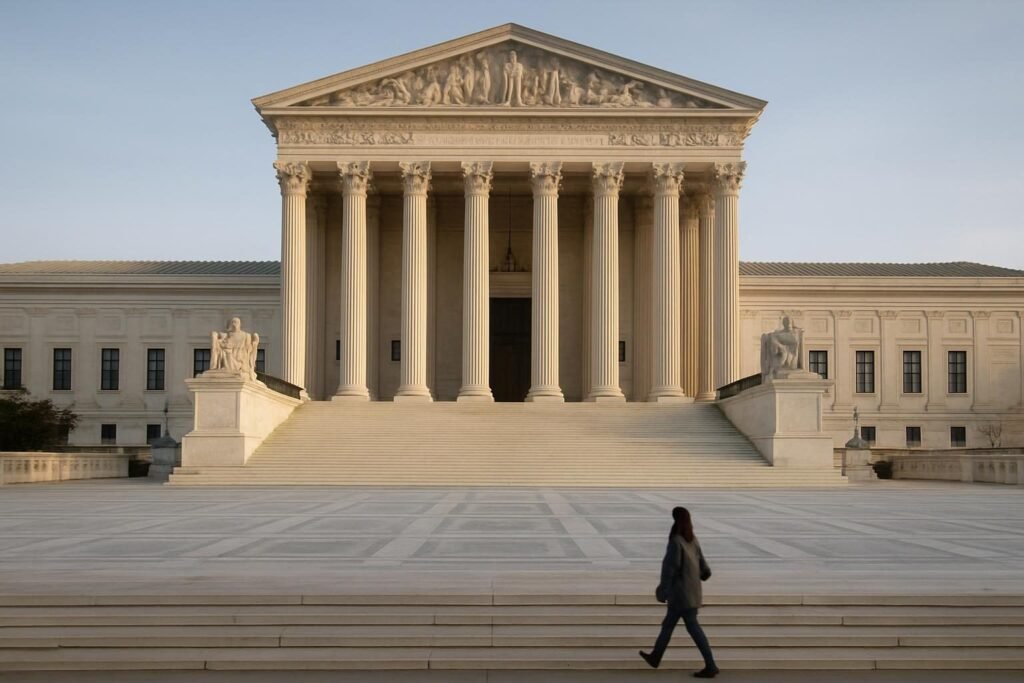
Few Supreme Court decisions are as famous, and as misunderstood, as Citizens United. People on the left and the right can name it instantly, yet many can’t say what it actually decided. This guide walks through the ruling, the strongest arguments on both sides, and what the evidence does and doesn’t show.
Quick answer: In Citizens United v. Federal Election Commission (2010), the Supreme Court ruled that the government cannot bar corporations and unions from spending their own money on independent political messages, because doing so restricts speech. It did not allow unlimited donations straight to candidates. Supporters see a defense of free speech; critics see a loophole for concentrated wealth.
What was the case actually about?
The case began with a nonprofit group called Citizens United, which made a film critical of Hillary Clinton during the 2008 presidential primaries. The group wanted to distribute it on television shortly before primary voting. A federal law, the Bipartisan Campaign Reform Act of 2002 (often called McCain-Feingold), restricted certain corporate and union-funded broadcast communications close to elections.
So the question before the Court was narrow on its face: could the government stop a corporation from paying to air a political film? The justices decided it could not, and the reasoning went well beyond one documentary.
What the Court decided
By a 5-4 vote, the majority held that the First Amendment protects political spending that is independent, meaning not coordinated with a candidate’s campaign. That protection, the Court said, does not disappear because the speaker is a corporation or a union.
The majority also reasoned that independent spending does not create corruption or the appearance of corruption in the way direct gifts to a candidate might. That claim is one of the most debated parts of the ruling, and we will come back to it.
What it did not decide
The ruling did not strike down limits on direct contributions to candidates. It did not erase disclosure rules entirely; in fact, the majority endorsed disclosure as a legitimate tool. And it did not say that corporations are people in every legal sense.
For a plain-language look at the institution that issued the ruling, see what the Supreme Court does and how it decides cases.
The legal ideas behind the decision
Three ideas do most of the work in this case. Understanding them makes the whole debate easier to follow.
- Speech and money. Earlier rulings, notably Buckley v. Valeo (1976), held that spending money to communicate political views is closely tied to speech. A rule limiting how much you can spend on an ad can limit how many people hear you.
- The identity of the speaker. The Court has long protected the speech of newspapers, which are usually corporations. The majority asked why a media company could speak freely while another kind of corporation could not.
- Corruption. Government can limit political money to prevent corruption. The question is how broadly to define it. The majority limited the concept mainly to quid pro quo exchanges, meaning “this for that” arrangements, while dissenters argued it should include undue influence and distorted access.
Notice that these are three separate questions: a legal one (what does the First Amendment protect?), a factual one (does independent spending corrupt?), and a values one (how should we weigh free expression against political equality?). Keeping them apart is the key to a calmer conversation.
The case for the ruling
Supporters of Citizens United make several arguments, and the strongest versions deserve a fair hearing.
- The First Amendment protects speech, not just speakers we like. The text says Congress shall make no law abridging freedom of speech. It does not say “except for groups organized as corporations.”
- Many corporations are nonprofits and advocacy groups. The ACLU, the NRA, the Sierra Club and many labor unions are organized groups. A rule that silences corporations can silence the very organizations ordinary people use to speak together.
- Government shouldn’t referee political speech. If officials can decide which political films or books are too close to an election, incumbents may have an incentive to write rules that protect themselves.
- Money buys reach, not votes. Voters still decide. Advocates note that heavily outspent candidates sometimes win, and that spending alone does not guarantee results.
The legal fight over campaign money is really a fight between two goods: the freedom to speak and the promise of equal voice.
The case against the ruling
Critics, who include people of many political leanings, offer their own serious arguments.
- Corporations aren’t voters. A company exists to make money for owners, and critics argue its political spending may reflect business interests rather than the views of the people who work for it or own its shares.
- Unlimited spending can drown out ordinary voices. When a few very large donors can fund huge ad campaigns, critics say the principle of political equality, one person, one voice, weakens in practice.
- Independence is partly a fiction. Critics argue that a candidate usually knows who is backing them, so “independent” spending can still create gratitude and access, even without a formal deal.
- Public confidence matters. If people believe the system favors the wealthy, they may disengage, which weakens self-government regardless of whether any law is broken.
Both sets of arguments hold real concerns. One side is worried about government control over speech. The other is worried about private power over government. These are two different fears about the same system, and each is rooted in a lesson from American history. For that background, see American history that explains today.

What changed after 2010?
The most visible change was the rise of Super PACs. A Super PAC is a committee that can raise and spend unlimited amounts to support or oppose candidates, provided it does not coordinate directly with a campaign. They grew out of Citizens United combined with a lower-court decision, SpeechNow.org v. FEC, that same year. This dynamic has reinforced the two-party system by giving major parties structural advantages in fundraising.
Here is a simple way to separate the pieces that are often blended together:
| Type of political money | General rule (check current law) |
|---|---|
| Direct donations to a candidate | Capped by federal limits; corporations barred from giving directly to federal candidates |
| Independent spending by a corporation or union | Allowed after Citizens United |
| Super PACs | Can raise and spend unlimited sums, but cannot coordinate with campaigns |
| Disclosure of donors | Required in some situations, but not all; rules vary |
Campaign finance law is detailed and changes with new rulings and regulations. For current figures and rules, consult the Federal Election Commission and your state election office. To learn how the money flows through different committees, see our planned guide on how political campaigns are funded.
The disclosure problem
Some groups that spend on elections are organized in ways that do not have to reveal their donors. Spending whose source is hidden from voters is often called “dark money.” People across the spectrum have criticized it, though they disagree about solutions, partly because donor privacy has its own free-association protections. We will dig into it in our guide on what dark money is.
What does the evidence show?
This is where honesty requires some humility. Researchers have studied campaign money for decades, and the findings are more mixed than either side’s slogans suggest.
- Outside spending increased. Independent expenditures by outside groups have grown substantially since 2010, by most accounts.
- Money does not guarantee victory. Many studies find that spending helps candidates less than people assume, especially after a candidate is already well known. Money can matter more in crowded primaries and for lesser-known challengers.
- Influence is hard to measure. Whether big donors shape policy, or simply back candidates who already agree with them, is difficult to prove either way. Scholars disagree about the size of the effect.
- Small donors have grown too. Online fundraising has also made it easier for large numbers of small donors to participate, and both parties now use it.
The fair summary: the ruling expanded who can spend and how much, but how much that has changed outcomes is still argued by serious people. When you read a confident claim in either direction, it is worth asking what evidence supports it. Our media literacy guide offers tools for exactly that.
Money can buy attention, but attention is not the same as persuasion, and persuasion is not the same as power.

Incentives: why the fight never ends
Nobody in this story needs to be a villain for the system to produce friction. Candidates need money to be heard, so they have a reason to court those who can provide it. Donors want a say in decisions that affect them. Voters want officials who answer to them. Courts want to protect rights without letting those rights undermine self-government. Understanding how these different parts interconnect can help clarify why campaign finance remains contentious.
Each group acts reasonably from where it stands, and the sum of those choices creates tension. This is a pattern we explore across American institutions in who has power in America, and it connects to how lobbying works and why it’s legal. For a simple tool you can use on any political fight, watch for our upcoming guide on following the incentives in politics.
Where reform ideas come from
People who want change propose very different paths. Some favor stronger disclosure so voters can see who funds what. Some favor public financing or matching programs for small donations. Others favor a constitutional amendment, which requires approval from Congress and the states. And some believe the best answer is to leave the ruling in place and rely on more speech from more voices.
Which approach is best depends partly on facts and partly on values, such as how much weight you give to free expression versus political equality. Reasonable people land in different places. The structure of the system itself, including how courts, Congress and states share power, is covered in separation of powers explained.
Think about it: Imagine a rule that limited political spending, and imagine it was written by the party currently in power. Would you trust it? Now imagine no limits at all. What would worry you? Notice which worry feels stronger, and ask someone who disagrees with you what they fear most.
How to talk about it with someone who disagrees
This topic can feel like a loyalty test, but it doesn’t have to. A good starting move is to ask, “What worries you most about the current rules?” Then listen for whether the concern is about government overreach, private influence, or something else entirely.
You may find more overlap than you expected. Many people on both sides dislike the sense that ordinary citizens have little say, and many on both sides value free speech. For practical conversation tips, see how to talk about politics with family. And if you want to act on what you’ve learned, local participation is a powerful place to start; 15 ways to show up beyond voting offers ideas.
You can also explore more of this theme in our Power & Incentives section.
Key takeaways
- Citizens United (2010) held that the government cannot ban independent political spending by corporations and unions, based on the First Amendment.
- It did not eliminate limits on direct contributions to candidates, and it did not require that corporations be treated as people in every respect.
- Supporters emphasize free speech and distrust of government control; critics emphasize political equality and the influence of concentrated wealth.
- The ruling, along with a related lower-court decision, helped create Super PACs and increased outside spending.
- Research on how much money changes elections is mixed, so confident claims on either side deserve scrutiny.
- Separating legal, factual and values questions makes the debate clearer and calmer.
Frequently asked questions
What did Citizens United actually decide?
In 2010, the Supreme Court ruled that the government cannot ban corporations and unions from spending their own money on independent political communications, such as ads that urge votes for or against candidates. The decision rested on the First Amendment’s protection of speech. It did not erase limits on direct contributions to candidates.
Did Citizens United make corporations people?
Not in the sense the slogan suggests. The idea that corporations and other groups have some constitutional rights, including speech rights, predates the case by a long time. The Court’s reasoning was about whether speech loses protection because of who the speaker is, not about declaring corporations human beings.
What is a Super PAC and how does it relate to the ruling?
A Super PAC is a political committee that can raise and spend unlimited sums to support or oppose candidates, as long as it does not coordinate directly with a campaign. Super PACs grew after Citizens United and a related lower-court decision, though the two rulings are often blended together in popular discussion.
Can a corporation give money directly to a candidate?
Federal law still restricts direct contributions from corporations to federal candidates, and individuals face contribution limits as well. Citizens United dealt with independent spending, not direct donations. Rules differ across states and change over time, so check the Federal Election Commission and your state election office for current details.
Can Citizens United be reversed?
There are two broad paths: the Supreme Court could overrule itself in a future case, or the Constitution could be amended. Amending it requires broad national agreement across many states, which is deliberately hard. Supporters and critics of the ruling both understand that this is a long-term question, not a quick fix.