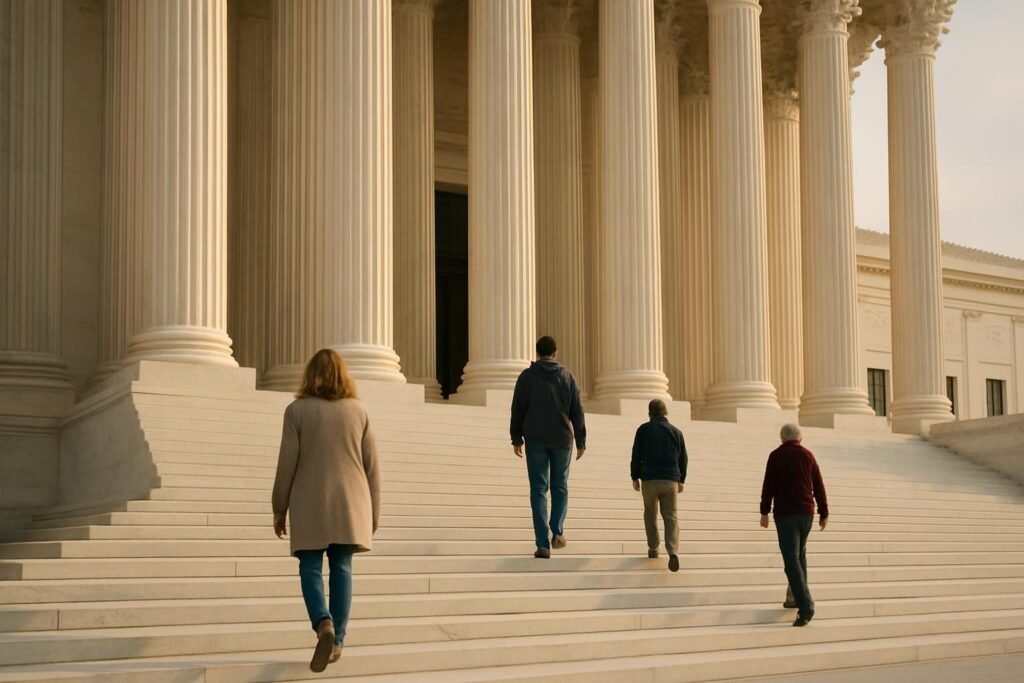
Every year, a handful of questions reach a small room in Washington that can reshape life for millions of people: what the government may do, what it may not, and what the nation’s founding document actually means. Most Americans can name the Supreme Court but struggle to say what it does day to day, and that gap fuels a lot of confusion and anger.
So what does the Supreme Court do? Let’s walk through it plainly, including the parts people argue about.
Quick answer: The Supreme Court is the highest court in the United States. It decides which cases to hear, settles disputes over what federal law and the Constitution mean, and can strike down laws and government actions that conflict with the Constitution. Nine justices, nominated by the president and confirmed by the Senate, serve for life.
The Supreme Court in one paragraph
The Court sits at the top of the federal judiciary, one of the three branches of government created by the Constitution under the federalism system. Its job is not to write laws (that is Congress) or to carry them out (that is the president and executive agencies). Its job is to interpret them when people disagree.
That interpretive role is more powerful than it sounds. When the Court says what a law or constitutional provision means, every lower court in the country is expected to follow. For a wider view of how the branches fit together, see our plain-language guide to how the US government works, or our explainer on how separation of powers works with real examples.
Judicial review: the Court’s biggest power
The power people most associate with the Court is judicial review: the authority to decide whether a law or government action violates the Constitution, and to declare it invalid if it does.
Here is a surprise for many readers: the Constitution never uses the words “judicial review.” The Court claimed the power in the 1803 case Marbury v. Madison, where Chief Justice John Marshall wrote that it is the job of the courts to say what the law is. Over two centuries, that claim has been accepted in practice by Congress, presidents and the public, though not without controversy. This power allows the Court to strike down laws and government actions—a authority famously exercised in cases ranging from civil rights to electoral disputes.
The case for judicial review
Supporters argue that a written Constitution means little if no one can enforce it against the government itself. If a legislature could pass any law it wanted, constitutional limits would be suggestions. An independent court, they say, protects minorities and individual rights from the passing passions of majorities.
The case for caution
Critics argue that nine unelected, life-tenured judges overriding the decisions of elected lawmakers sits uneasily with self-government. Some prefer that Congress, the states and voters resolve more questions themselves. Others accept judicial review but disagree about how restrained courts should be. This tension is part of the broader debate about how a republic differs from a pure democracy.
Notice that both sides share a value: they want government limited by law. They differ on who should be trusted as the referee. That is a disagreement about values and institutional design, not simply about facts.
Nothing in the Constitution says “judicial review.” The Court claimed the power in 1803, and the country has largely accepted it ever since.

How a case actually reaches the Supreme Court
The Court does not roam the country looking for problems to fix. It only decides actual disputes brought by real parties, and it hears only a tiny fraction of the cases people ask it to take.
The usual path
- A dispute begins. Someone is harmed, charged with a crime, or challenges a law or government action. The case starts in a trial court, either federal or state.
- Appeals. The losing side can appeal to a higher court. In the federal system, that means a circuit court of appeals. In state systems, it usually means state appellate courts and then a state supreme court.
- A petition. The losing party asks the Supreme Court to hear the case by filing a petition for a writ of certiorari (often shortened to “cert”), which is simply a request for the Court to review a lower court’s decision.
- The vote to hear it. By long-standing practice, four of the nine justices must agree to take a case. This is often called the “rule of four.”
- Briefs and arguments. Lawyers submit written arguments, and then each side typically gets a limited time to argue in person while justices interrupt with questions.
- Conference and opinion. The justices meet privately, vote, and one justice writes the majority opinion. Others may write concurrences (agreeing, with different reasoning) or dissents (disagreeing).
Why so few cases?
Thousands of petitions arrive each year (commonly cited as roughly 7,000 or more), and the Court usually agrees to hear only around 60 to 80 cases. These figures are approximate and vary by year, so check the Court’s website for current numbers.
What gets chosen? Often, cases where federal appeals courts have split on the same legal question, or cases involving major constitutional or national issues. The Court is not mainly correcting individual mistakes. It is deciding questions whose answers will govern many other cases.
Original jurisdiction: the rare exception
A few kinds of cases, such as certain disputes between states, can begin directly at the Supreme Court. These are uncommon compared with appeals.
What the Court’s decisions actually do
A ruling decides the specific dispute, but its larger impact comes from precedent: the principle that courts should generally follow earlier decisions on the same question. Latin speakers call it stare decisis, “to stand by things decided.”
Precedent gives law stability. You and your business can plan around rules that will not flip every year. But the Court is not frozen. It has overturned earlier rulings when a majority concluded they were wrongly decided, and history includes major reversals in both directions politically.
| What the Court can do | What it generally cannot do |
|---|---|
| Interpret federal laws and the Constitution | Write or pass legislation |
| Strike down laws or actions that violate the Constitution | Enforce its own rulings without the executive branch and others |
| Set precedents lower courts follow | Issue advisory opinions on hypothetical questions |
| Choose most of the cases it hears | Take up a case no one has brought |
That second column matters. The Court has no army or police force. Its rulings work because other officials and citizens choose to comply. That voluntary acceptance is one of the quiet foundations of the American system.
The Court has no army and no budget power over the other branches. Its rulings work because the country chooses to follow them.

How justices get appointed
The Constitution gives the president the power to nominate justices and the Senate the power to confirm them with “advice and consent.” That is the whole formal recipe. The details have developed over time.
The steps
- A vacancy occurs through retirement, death, or (very rarely) removal.
- The president nominates someone. Presidents often choose people whose legal views they believe align with their own.
- The Senate Judiciary Committee holds hearings, questions the nominee, and votes on a recommendation.
- The full Senate votes. For Supreme Court nominees, a simple majority is now enough. Senate rules on this have changed over time, which connects to debates covered in our explainer on the filibuster.
Why life tenure?
Justices serve “during good behavior,” which in practice means for life unless they retire or are impeached and convicted (which has never happened to a justice). The framers wanted judges insulated from political pressure so they could rule against popular positions or powerful officials.
The tradeoff is real. Life tenure gives independence, but it also means a single president’s appointments can shape the Court for decades, and timing of vacancies can feel like luck. Proposals to change this, such as term limits or changing the number of seats, come from across the political spectrum at different moments, usually depending on who feels disadvantaged. Some would require a constitutional amendment; others could be done by statute. Reasonable people argue over whether such changes would strengthen or weaken the Court’s independence.
The number nine
The Constitution does not fix the number of justices. Congress sets it, and it has varied over the nation’s history before settling at nine in 1869. Because Congress controls the number, proposals to change it come up periodically.
The “shadow docket” explained
Most people picture the Court as holding arguments, then issuing a lengthy written opinion months later. That is the “merits docket.” But there is another channel, informally called the shadow docket, a term popularized by legal scholar William Baude to describe the Court’s emergency and procedural orders. The Court itself does not use the label, and some justices and scholars dislike it.
What it is
Sometimes a party asks the Court to act quickly, before a full case can be argued. Examples include requests to pause a lower court’s order, to allow or block a policy while litigation continues, or to delay an execution. The Court often decides these through short orders, sometimes with little or no explanation, and without full oral argument.
Why it is controversial
Critics say these rulings can have major real-world consequences while skipping the transparency of full briefing, argument and written reasoning. They worry the public cannot see how decisions were made, and that lower courts get little guidance. Supporters respond that emergencies require speed, that the Court cannot hold full proceedings on every urgent request, and that interim orders are not final decisions on the merits.
Where the evidence points
It is a fact that the Court has used emergency orders more visibly in recent years, and that some have carried high stakes. Whether that reflects a troubling shift or a response to more emergency requests is disputed, and the answer often depends on one’s view of the underlying cases. A fair test is consistency: would you accept the same procedure if the other side benefited? That question helps separate concerns about process from preferences about outcomes.

Why people disagree about the Court
Arguments about the Court often sound like arguments about politics, but several are really about method. Two broad approaches are commonly described:
- Originalism and textualism: interpreting the Constitution and statutes according to their original meaning or ordinary text, on the theory that this constrains judges and keeps law tied to what lawmakers and ratifiers adopted.
- Living constitutionalism or pragmatic approaches: reading broad constitutional language in light of changing circumstances, precedent and practical consequences, on the theory that general principles must be applied to a changing society.
Each camp has serious scholars, and each accuses the other of sneaking in personal preferences. Most judges blend elements of several approaches. Understanding the method behind a ruling often tells you more than knowing the political label attached to a justice.
Incentives matter too. Interest groups, presidents and senators care intensely about appointments because the Court’s decisions are durable and hard to reverse. That is part of why confirmations feel so high-stakes. For more on how institutions and incentives shape outcomes, read who has power in America.
History is part of the picture, too. The Court has issued rulings that later generations widely regard as grave errors, including decisions that upheld slavery and racial segregation, and rulings that expanded rights and corrected earlier wrongs. Our guide to American history that explains today offers context for how those decisions fit into larger struggles.
How to follow the Court without being misled
Headlines about the Court are often compressed into “winners and losers,” which flattens real legal reasoning. A few habits help:
- Read the primary source. Opinions are posted at supremecourt.gov. Even skimming the syllabus (the summary at the top) helps.
- Notice the question presented. Courts often decide narrower questions than headlines suggest.
- Read the dissent. It usually states the strongest opposing view.
- Watch the framing. Our media literacy guide shows how coverage shapes perception.
The Court also interacts with the rest of government. Congress can pass new laws in response to statutory rulings, and constitutional rulings can be altered through amendment, a process that is intentionally difficult. For how legislation starts, see how a bill becomes a law. And for the text the Court interprets, look ahead to our upcoming guide on what the Constitution actually says.
Think about it: If you disagreed with a Supreme Court ruling, which would bother you more: the outcome, or the way the decision was reached? Would your answer change if the ruling went the other way? Try discussing this with someone who sees it differently, using our guide to talking about politics with family.
Key takeaways
- The Supreme Court is the highest federal court and the final interpreter of federal law and the Constitution in the cases it hears.
- Judicial review, the power to strike down unconstitutional laws, was claimed in 1803 and is not spelled out in the Constitution.
- Cases arrive through appeals and a petition called certiorari; the Court takes only a small fraction of them.
- Justices are nominated by the president, confirmed by the Senate, and serve for life, which creates both independence and high-stakes appointment fights.
- The shadow docket refers to emergency orders issued without full argument; supporters cite speed, critics cite transparency.
- Many disputes about the Court are about method and institutional design, not only about political outcomes.
Frequently asked questions
What does the Supreme Court do in simple terms?
It is the highest court in the United States and the final word on what federal law and the Constitution mean in the cases it chooses to hear. It settles disagreements among lower courts, decides whether government actions are constitutional, and sets precedents that lower courts must follow.
How many justices are on the Supreme Court?
Nine today: one chief justice and eight associate justices. The Constitution does not set the number. Congress does, and it has changed the number several times in the nation’s history, though it has stayed at nine since 1869.
Can the Supreme Court make laws?
Formally, no. Congress writes federal laws and the president signs them. But when the Court interprets a law or the Constitution, its reading becomes binding, which gives its decisions the practical force of law. Congress can respond by passing a new statute, and the people can amend the Constitution, though both are difficult.
Can anyone overrule the Supreme Court?
Not directly. A Supreme Court interpretation of a statute can be changed if Congress passes a new law. An interpretation of the Constitution can only be changed by constitutional amendment or by a later Court decision that overturns the earlier one. The Court has overturned its own past rulings many times.
How can I read what the Supreme Court is doing right now?
The Court’s official website, supremecourt.gov, posts opinions, the argument calendar, dockets and transcripts. Reading the actual opinion, rather than only a summary, lets you see the reasoning for yourself, including the dissent. For the wider picture of how this fits into the system, return to our Civic Foundations section.