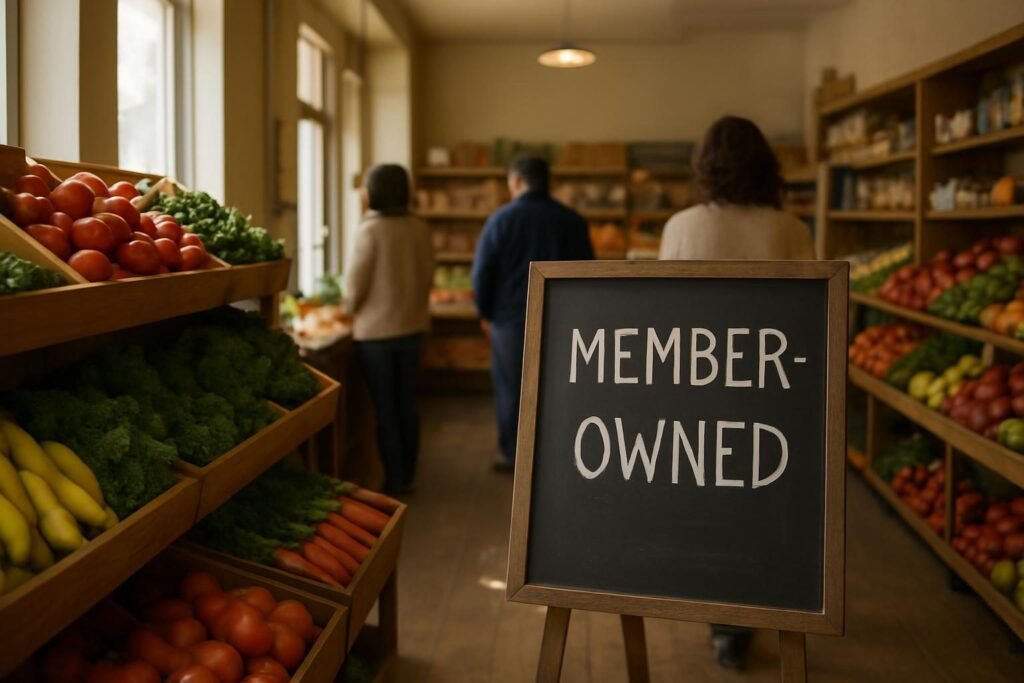
Most of us deal with businesses every day without asking who actually owns them. For almost all of them, the answer is shareholders. But there is another model, one that millions of Americans use through their credit union, electric utility or grocery store.
It is called a cooperative, and it asks a simple question: what if the people who use a business also owned it?
Quick answer: A cooperative is a business owned and democratically controlled by its members, who may be customers, workers or producers. In a typical co-op each member gets one vote, and surplus earnings are shared according to how much each member participated, not how much money they invested. A corporation is owned by shareholders, who usually get votes and profits in proportion to the shares they hold.
What is a cooperative in business?
A cooperative, or co-op, is a business set up so that its members own it together. Members are the people the business exists to serve. They might be shoppers at a food co-op, farmers who pool their crops to sell, employees who own their workplace, or households that buy power from a member-owned utility.
The core idea is that the business serves its members’ needs first, rather than maximizing returns for distant investors. Many co-ops around the world follow a shared set of principles that includes voluntary membership, democratic member control, and members’ economic participation. These are guidelines, not laws, and individual co-ops apply them differently.
Co-ops are real businesses. They pay bills, compete with other firms, and can lose money or go under. What differs is who holds the ownership and decision-making power.
The main kinds of cooperatives
Co-ops are organized around the relationship members have with the business. The common types look like this:
- Consumer co-ops: owned by the people who buy from them, like food co-ops, outdoor-gear co-ops and credit unions.
- Producer or agricultural co-ops: owned by farmers or makers who pool resources to process, market or buy supplies together.
- Worker co-ops: owned and governed by the people who work there.
- Utility co-ops: owned by the customers they serve, most visibly rural electric cooperatives.
- Housing co-ops: where residents collectively own the building and each holds a share that gives them the right to live in a unit.
For more on how these look in practice, we have a planned guide on examples of cooperatives in America, from credit unions to farms to utilities, and a broader explainer on how worker and community co-ops work.

Who owns the business?
In a corporation, ownership comes from buying stock. A shareholder might be a retiree with a few shares in a retirement fund, a founder with a large stake, or a pension fund managing money for teachers. Owners are often separate from customers and employees, and they may never set foot in the business.
In a co-op, ownership comes from membership. You become an owner by being a customer, worker or producer, usually by paying a modest membership fee or buying a share. The ownership stake is tied to your relationship with the business, not to how much capital you can invest.
This matters for incentives. A corporation’s legal and financial structure points toward returns for its owners, which usually means shareholders. A co-op’s structure points toward the interests of its members, who are also its users. Neither is automatically better. They aim at different goals.
In a corporation, money buys a voice. In a co-op, membership does.
How are decisions made?
This is where the two models differ most visibly.
In a typical corporation, shareholders vote on major matters such as electing the board of directors, but votes are weighted by shares. A person holding more shares has more votes. Day-to-day decisions are made by executives hired by the board.
In a typical co-op, each member has one vote, whether they hold a small stake or a larger one. Members elect a board, and the board hires or oversees management. Some small worker co-ops make many decisions together, while larger ones rely on elected representatives and professional managers, much like a corporation.
Here is a side-by-side look at the usual patterns. Details vary by state, by industry and by each organization’s bylaws.
| Feature | Typical cooperative | Typical corporation |
|---|---|---|
| Who owns it | Members (users, workers or producers) | Shareholders |
| How you become an owner | Join as a member, often by buying a share | Buy stock |
| Voting | Usually one member, one vote | Usually one share, one vote |
| Who sets direction | Elected board, accountable to members | Board elected by shareholders |
| Profit sharing | Surplus returned based on participation | Dividends or stock gains based on shares held |
| Raising money | Member capital, loans, retained earnings | Selling stock and bonds |
How are profits shared?
Corporations share profits with owners in proportion to what they own. A company might pay dividends, buy back shares, or reinvest earnings so that the stock becomes more valuable. Someone holding twice as many shares gets twice the payout.
Co-ops use what is often called a patronage model. Surplus is typically returned to members according to how much they used or contributed to the business. In a food co-op, that might mean a rebate based on how much you spent. In a worker co-op, it might be based on hours worked or pay level. In a farm co-op, it might be based on the volume of crops sold through it.
Co-ops often keep part of the surplus to reinvest in the business, and the share paid out to members varies. Tax treatment of these payments is complicated and depends on the type of co-op, so members and founders should consult a qualified tax professional and current official sources rather than relying on a general article.
It is worth separating a fact from a value here. As a matter of fact, the two models distribute earnings by different rules. Whether it is fairer to reward capital or participation is a values question, and thoughtful people land in different places.

Where co-ops show up in American life
Co-ops are woven into American history and daily life, even if people rarely notice. Credit unions are member-owned financial cooperatives. Many rural areas get electricity from member-owned electric cooperatives, a model that grew in the twentieth century when private utilities were often unwilling to string lines to sparsely populated farmland. Farmers have long formed cooperatives to market crops, buy supplies and negotiate with larger buyers. Housing co-ops help members afford homes in high-cost areas, addressing challenges that also drive why apartment rent is so high.
These examples tend to share a pattern. Co-ops often arise when a group has a shared need that the existing market is not meeting well, and when members can pool resources to meet it. That is a useful lens on the history of Black banks in America and on how communities have built their own institutions when mainstream ones left them out. For the broader picture of how law and policy shaped who could build wealth, see our guide to how policy shaped wealth in America.
The case for cooperatives
Supporters make several arguments, and it helps to hear them in their strongest form.
- Aligned incentives. When owners are also customers or workers, the business has less reason to extract value from them. Supporters argue this can mean fairer prices, steadier service or better treatment of employees.
- Rooted in community. Because members live and work locally, supporters say co-ops are less likely to relocate or close for distant financial reasons.
- Shared ownership and opportunity. Co-ops can let people with modest savings own part of a business, which supporters see as a way to broaden who builds assets. That connects to the larger conversation about generational wealth and how families build it.
- Democratic habits. Voting for a board and weighing in on business choices gives members practice in the kind of self-government that civic life depends on. If you are curious how that compares to government, see our explainer on republic versus democracy.
Every ownership model is a bet about who should carry the risk and who should share the reward.
The limits and challenges of the co-op model
Critics and honest supporters alike point to real difficulties. These are not reasons to dismiss co-ops, but they explain why the model is not more common.
- Raising capital. Corporations can sell stock to investors anywhere. Co-ops usually rely on member contributions, loans and retained earnings. Growing quickly, or funding a risky venture, can be harder.
- Slower decisions. Democratic governance can take time. Critics argue that markets sometimes reward speed and bold bets, and that member votes can favor caution or short-term benefits for current members.
- Management and expertise. Elected boards may lack business experience, and members may not participate much. Low turnout at co-op elections is a common concern, and it can leave control with a small, active group.
- Risk concentration. In a worker co-op, employees may have both their job and their savings tied to one business. Critics argue that diversification, spreading risk across investments, is wiser. Supporters respond that workers already depend on their employer for income, and that ownership gives them a say.
- Legal and financial complexity. Rules for co-ops vary by state and by type, and not every lender or advisor knows the model well. Check current official sources and qualified professionals.
- Trade-offs in pay and growth. Some co-ops choose stability and fair wages over maximum growth. Whether that is a feature or a flaw depends on what you value.
Evidence on how co-ops perform compared to conventional firms is mixed and depends on industry, size and how success is measured. Be wary of anyone, on any side, who claims a clean verdict.
What critics and supporters each get right
Supporters are right that ownership structure shapes behavior, and that business does not have to follow only one template. Co-ops have lasted for generations in sectors like agriculture, utilities and finance, which suggests the model can work.
Critics are right that capital, speed and expertise matter, and that a democratic structure does not guarantee good management. The corporate model also has real strengths, including the ability to pool large amounts of money from many investors and spread risk widely, which has helped finance everything from railroads to modern medicine.
A fair reading is that the two models solve different problems. Corporations are strong at raising capital and scaling. Co-ops are strong at aligning a business with the people it serves. Many economies use both, and many real-world organizations blend features of each.
The deeper debate is partly about values. How much should ownership be tied to investment versus participation? How much should a business answer to shareholders versus members, workers or communities? Those are questions about freedom, fairness and responsibility, and reasonable Americans of all political leanings answer them differently. For a guide to discussing disagreements like these without the fight, see how to talk about politics with family.
Think about it: Imagine the business you use most, whether a bank, grocery store or utility. Who owns it today, and how would your experience change if you did, with one vote and a share of the surplus? What would you gain, and what would you worry about?
Why this matters for opportunity
Ownership is one of the ways Americans build wealth, and it is not evenly spread. Who gets to own a business, a home or a share of a company is shaped by markets, laws and history. Co-ops are one experiment in widening access to ownership, and corporations are another way, through stock held directly or in retirement accounts. For a wider view, see our planned guide to how Americans build wealth through homes, retirement accounts and businesses and our hub on money, housing and opportunity.
Housing offers a concrete case. Some communities use cooperative ownership to keep homes within reach, while others focus on building more supply. Those debates connect to why houses are so expensive right now.
Key takeaways
- A cooperative is a business owned and controlled by its members, who may be customers, workers or producers.
- Co-ops typically give each member one vote, while corporations typically weight votes by shares owned.
- Co-op surplus is usually shared by participation, while corporate profits go to owners by how much stock they hold.
- Supporters point to aligned incentives and community roots, while critics point to limited capital, slower decisions and uneven member involvement.
- Evidence on performance is mixed, and the choice between models partly reflects values about ownership, risk and fairness.
- Laws and tax rules for co-ops vary, so check current official sources and qualified professionals before starting or joining one.
Frequently asked questions
What is a cooperative in business, in simple terms?
A cooperative is a business owned and controlled by the people who use it or work in it, such as customers, workers, farmers or members. Each member typically gets one vote regardless of how much money they put in, and surplus earnings are generally shared based on how much each member participated.
Is a cooperative the same as a nonprofit?
No. Most cooperatives are for-profit businesses that aim to cover costs and earn surplus, but they distribute that surplus to members rather than to outside investors. Nonprofits have a different legal structure and generally cannot distribute profits to owners at all. Rules vary by state and by type of organization, so check current official sources.
Do cooperatives have to be small or local?
No. Some cooperatives are small neighborhood businesses, while others are large, such as agricultural marketing co-ops, rural electric cooperatives and credit unions that serve many thousands of members. Size depends on the model, the industry and the community it serves.
Why aren’t there more cooperatives if they treat members so well?
Supporters and critics give different answers. Common explanations include difficulty raising startup money, limited access to outside investors, the time that democratic decisions can take, and the fact that most founders and lenders are more familiar with the corporate model. Cooperatives have also thrived in particular fields, such as farming, utilities and finance.
Can I start or join a cooperative?
Many people do. You can join an existing co-op, such as a credit union, food co-op or electric co-op, often by buying a membership share or meeting service requirements. Starting one involves legal and financial choices, so talk with a qualified attorney or a cooperative development organization and check your state’s current rules.